

Post Exertional Malaise: When Activity Causes A Delayed Crash
Meta Description: Post exertional malaise can cause a delayed worsening of fatigue, pain, brain fog, and other symptoms after physical or mental activity. Learn how PEM differs from ordinary tiredness, why activity records matter, and how Functional Capacity Evaluations may help document real world limitations in people with ME/CFS, Long COVID, and other complex conditions
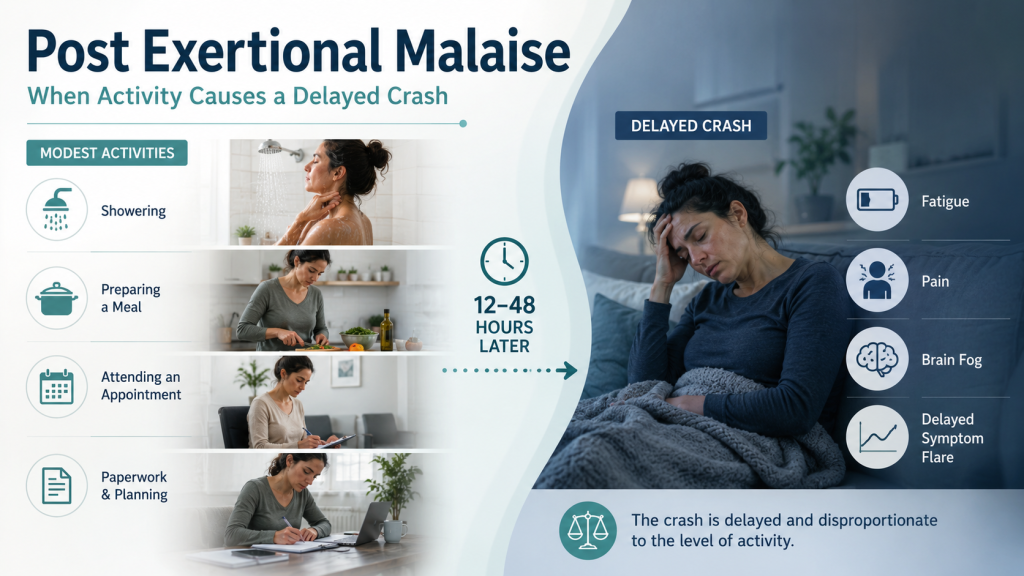
Post exertional malaise, commonly called PEM, is more than ordinary tiredness after a busy day. It is a worsening of symptoms following physical, mental, or emotional activity that a person may once have tolerated without difficulty. PEM is strongly associated with myalgic encephalomyelitis and chronic fatigue syndrome, often written as ME/CFS. It is also reported by some people living with Long COVID.
What Does Post Exertional Malaise Feel Like?
The experience is different for each person. Some describe profound exhaustion, while others experience increased pain, headaches, dizziness, disturbed sleep, flu like symptoms, or difficulty thinking clearly. A routine activity such as showering, preparing a meal, attending an appointment, or concentrating on paperwork may be enough to trigger a decline.
One of the most important features of PEM is that the reaction may be delayed. Symptoms often become worse 12 to 48 hours after the activity. The effects can continue for days or even weeks. This delay can make it difficult for patients, families, employers, and evaluators to connect an activity with the symptoms that follow.
PEM Is Not The Same As Normal Fatigue
Most people feel tired after strenuous activity and improve with ordinary rest. PEM is different because the response can be disproportionate to the effort involved. A person may appear to complete a task successfully, only to experience a significant reduction in function later.
This pattern may create a cycle sometimes described as push and crash. On a better day, the person tries to catch up on work, errands, or household responsibilities. The extra effort then triggers a setback that reduces activity for several days.
Why Activity Records Can Be Helpful
Keeping a simple record of activities and symptoms may help identify personal limits. Useful details can include the type of activity, how long it lasted, symptoms during the task, and changes later that day or over the following two days.
This information can also help healthcare professionals understand how symptoms affect real life function. A single snapshot may not show the full picture when the most serious effects occur after the activity has ended.
The Role Of Functional Evaluation
A Functional Capacity Evaluation does not diagnose ME/CFS, Long COVID, or post exertional malaise. However, an appropriately planned evaluation may provide useful information about physical tolerance, cognitive endurance, task performance, consistency, and recovery.
For individuals with fatigue related conditions, the timing and structure of an evaluation matter. Observations made across more than one day may reveal changes that are not apparent during a brief appointment. Cognitive Functional Capacity Evaluations may also examine attention, memory, executive functioning, pace, and the ability to sustain activity.
Managing Activity With Professional Guidance
The Centers for Disease Control and Prevention describes pacing as a strategy used to balance activity and rest while remaining within individual limits. People should discuss significant or persistent symptoms with a qualified healthcare provider before changing their activity or exercise routines.
Learn More About Functional Capacity Evaluations
MEASURAbilities provides Functional Capacity Evaluations and Cognitive Functional Capacity Evaluations for complex medical and disability related cases. Our evaluations focus on real world function, careful observation, and clear documentation. To discuss an appropriate evaluation for your client or case, contact MEASURAbilities at 480.285.6212.
References
Centers for Disease Control and Prevention, Strategies to Prevent Worsening of Symptoms.
Centers for Disease Control and Prevention, Symptoms of ME/CFS.
National Institute for Health and Care Excellence, ME/CFS Diagnosis and Management Guideline.