
Written by Craig B

Post Exertional Malaise: When Activity Causes A Delayed Crash

Meta Description: Post exertional malaise can cause a delayed worsening of fatigue, pain, brain fog, and other symptoms after physical or mental activity. Learn how PEM differs from ordinary tiredness, why activity records matter, and how Functional Capacity Evaluations may help document real world limitations in people with ME/CFS, Long COVID, and other complex conditions
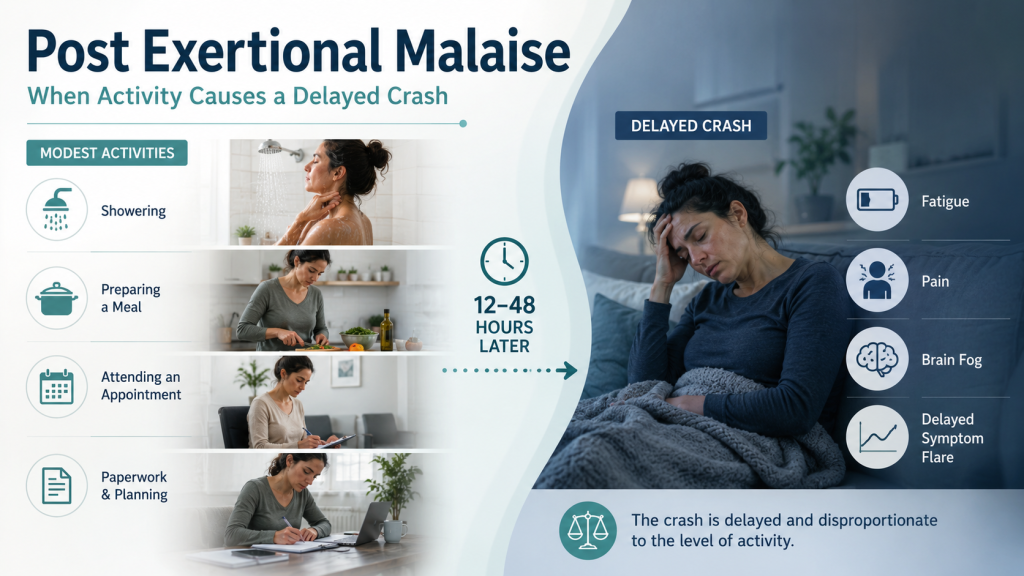
Post exertional malaise, commonly called PEM, is more than ordinary tiredness after a busy day. It is a worsening of symptoms following physical, mental, or emotional activity that a person may once have tolerated without difficulty. PEM is strongly associated with myalgic encephalomyelitis and chronic fatigue syndrome, often written as ME/CFS. It is also reported by some people living with Long COVID.

What Does Post Exertional Malaise Feel Like?

The experience is different for each person. Some describe profound exhaustion, while others experience increased pain, headaches, dizziness, disturbed sleep, flu like symptoms, or difficulty thinking clearly. A routine activity such as showering, preparing a meal, attending an appointment, or concentrating on paperwork may be enough to trigger a decline.

One of the most important features of PEM is that the reaction may be delayed. Symptoms often become worse 12 to 48 hours after the activity. The effects can continue for days or even weeks. This delay can make it difficult for patients, families, employers, and evaluators to connect an activity with the symptoms that follow.

PEM Is Not The Same As Normal Fatigue

Most people feel tired after strenuous activity and improve with ordinary rest. PEM is different because the response can be disproportionate to the effort involved. A person may appear to complete a task successfully, only to experience a significant reduction in function later.

This pattern may create a cycle sometimes described as push and crash. On a better day, the person tries to catch up on work, errands, or household responsibilities. The extra effort then triggers a setback that reduces activity for several days.

Why Activity Records Can Be Helpful

Keeping a simple record of activities and symptoms may help identify personal limits. Useful details can include the type of activity, how long it lasted, symptoms during the task, and changes later that day or over the following two days.

This information can also help healthcare professionals understand how symptoms affect real life function. A single snapshot may not show the full picture when the most serious effects occur after the activity has ended.

The Role Of Functional Evaluation

A Functional Capacity Evaluation does not diagnose ME/CFS, Long COVID, or post exertional malaise. However, an appropriately planned evaluation may provide useful information about physical tolerance, cognitive endurance, task performance, consistency, and recovery.

For individuals with fatigue related conditions, the timing and structure of an evaluation matter. Observations made across more than one day may reveal changes that are not apparent during a brief appointment. Cognitive Functional Capacity Evaluations may also examine attention, memory, executive functioning, pace, and the ability to sustain activity.

Managing Activity With Professional Guidance

The Centers for Disease Control and Prevention describes pacing as a strategy used to balance activity and rest while remaining within individual limits. People should discuss significant or persistent symptoms with a qualified healthcare provider before changing their activity or exercise routines.

Learn More About Functional Capacity Evaluations

MEASURAbilities provides Functional Capacity Evaluations and Cognitive Functional Capacity Evaluations for complex medical and disability related cases. Our evaluations focus on real world function, careful observation, and clear documentation. To discuss an appropriate evaluation for your client or case, contact MEASURAbilities at 480.285.6212.

References

Centers for Disease Control and Prevention, Strategies to Prevent Worsening of Symptoms.

Centers for Disease Control and Prevention, Symptoms of ME/CFS.

National Institute for Health and Care Excellence, ME/CFS Diagnosis and Management Guideline.
Written by Craig B

Long COVID And The Demands Of A Workday

A person gets ready for work, drives to the office, and makes it through the morning without any obvious difficulty. By lunchtime, concentration has slipped. Routine decisions take longer. A conversation with a customer becomes hard to follow. After arriving home, the person needs the rest of the evening to recover. The next morning may be better. Or it may be worse. That uneven pattern is familiar to many people living with Long COVID. It also makes work ability difficult to judge. Looking well during one appointment does not show how somebody functions across an entire day or what happens after the activity is over. The Problem Is Often Staying Power Most jobs require more than completing an isolated task. Employees must repeat movements, remember information, adjust to interruptions, keep an acceptable pace, and make sound decisions when they are tired. Long COVID can interfere with any of these demands. The Centers for Disease Control and Prevention lists fatigue, shortness of breath, dizziness, sleep disturbance, memory problems, and difficulty concentrating among its possible symptoms. Some people also feel worse after physical or mental exertion. Imagine a warehouse employee who can lift twenty pounds several times but loses strength quickly after that. An accountant might work accurately for thirty minutes, then begin missing figures as mental fatigue builds. Both people performed the task. Neither necessarily demonstrated the ability to sustain it as a job requires. Why Medical Records May Leave Questions Medical records establish the history of an illness, its symptoms, and the care a person has received. They do not automatically explain how long somebody can stand, whether instructions are remembered, or how accurately work is performed once fatigue appears. Long COVID presents another difficulty because there is no single laboratory result that measures its effect on daily function. A person can have significant limitations even when routine findings offer little explanation for them. A closer look at performance may therefore be needed. What happens when activity continues? Does the person slow down? Are more mistakes made? Is extra rest required? How long does recovery take? Those details matter when deciding whether a return to work is safe and realistic. Looking At Physical And Cognitive Function Together A Functional Capacity Evaluation may examine lifting, carrying, walking, reaching, coordination, positional tolerances, and endurance. When cognitive complaints are involved, the evaluation can also consider attention, memory, planning, pace, decision making, and the ability to handle several instructions. The evaluator observes more than the final result. Effort, consistency, body mechanics, safety, accuracy, and changes in performance all contribute to the findings. Job demands can then be compared with the abilities demonstrated during testing. For some Long COVID cases, the interaction between physical and mental fatigue is especially revealing. Concentration may fade after exertion. A physically simple activity may become difficult when planning and memory are added. Examining these demands together produces a fuller account of the workday. Finding The Right Evaluation For A Long COVID Case MEASURAbilities provides functional and cognitive evaluations for individuals whose medical conditions have affected their ability to work. Testing is selected according to the referral question, reported symptoms, and relevant occupational demands. If Long COVID has created uncertainty about work capacity, restrictions, or a disability claim, contact MEASURAbilities. Our team can discuss the case and help determine which type of evaluation is most appropriate. Call MEASURAbilities For Long COVID Work Capacity Evaluations Long COVID can make the demands of a workday difficult to measure without a structured look at function, endurance, pace, and recovery. MEASURAbilities provides evaluations that help clarify how physical and cognitive symptoms may affect job performance, return to work planning, restrictions, and disability related questions. Call MEASURAbilities today at 480.214.9725 to discuss the case and determine the most appropriate evaluation.

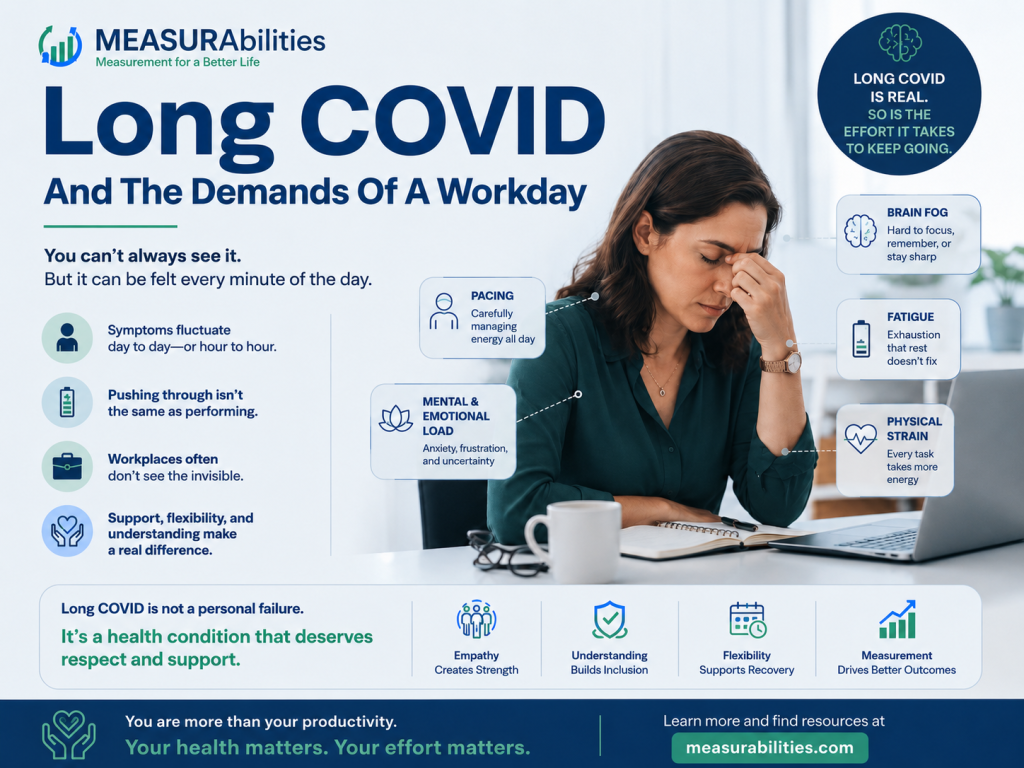
A person gets ready for work, drives to the office, and makes it through the morning without any obvious difficulty. By lunchtime, concentration has slipped. Routine decisions take longer. A conversation with a customer becomes hard to follow. After arriving home, the person needs the rest of the evening to recover.

The next morning may be better. Or it may be worse.

That uneven pattern is familiar to many people living with Long COVID. It also makes work ability difficult to judge. Looking well during one appointment does not show how somebody functions across an entire day or what happens after the activity is over.

The Problem Is Often Staying Power

Most jobs require more than completing an isolated task. Employees must repeat movements, remember information, adjust to interruptions, keep an acceptable pace, and make sound decisions when they are tired.

Long COVID can interfere with any of these demands. The Centers for Disease Control and Prevention lists fatigue, shortness of breath, dizziness, sleep disturbance, memory problems, and difficulty concentrating among its possible symptoms. Some people also feel worse after physical or mental exertion.

Imagine a warehouse employee who can lift twenty pounds several times but loses strength quickly after that. An accountant might work accurately for thirty minutes, then begin missing figures as mental fatigue builds. Both people performed the task. Neither necessarily demonstrated the ability to sustain it as a job requires.

Why Medical Records May Leave Questions

Medical records establish the history of an illness, its symptoms, and the care a person has received. They do not automatically explain how long somebody can stand, whether instructions are remembered, or how accurately work is performed once fatigue appears.

Long COVID presents another difficulty because there is no single laboratory result that measures its effect on daily function. A person can have significant limitations even when routine findings offer little explanation for them.

A closer look at performance may therefore be needed. What happens when activity continues? Does the person slow down? Are more mistakes made? Is extra rest required? How long does recovery take?

Those details matter when deciding whether a return to work is safe and realistic.

Looking At Physical And Cognitive Function Together

A Functional Capacity Evaluation may examine lifting, carrying, walking, reaching, coordination, positional tolerances, and endurance. When cognitive complaints are involved, the evaluation can also consider attention, memory, planning, pace, decision making, and the ability to handle several instructions.

The evaluator observes more than the final result. Effort, consistency, body mechanics, safety, accuracy, and changes in performance all contribute to the findings. Job demands can then be compared with the abilities demonstrated during testing.

For some Long COVID cases, the interaction between physical and mental fatigue is especially revealing. Concentration may fade after exertion. A physically simple activity may become difficult when planning and memory are added. Examining these demands together produces a fuller account of the workday.

Finding The Right Evaluation For A Long COVID Case

MEASURAbilities provides functional and cognitive evaluations for individuals whose medical conditions have affected their ability to work. Testing is selected according to the referral question, reported symptoms, and relevant occupational demands.

If Long COVID has created uncertainty about work capacity, restrictions, or a disability claim, contact MEASURAbilities. Our team can discuss the case and help determine which type of evaluation is most appropriate.

Call MEASURAbilities For Long COVID Work Capacity Evaluations

Long COVID can make the demands of a workday difficult to measure without a structured look at function, endurance, pace, and recovery. MEASURAbilities provides evaluations that help clarify how physical and cognitive symptoms may affect job performance, return to work planning, restrictions, and disability related questions. Call MEASURAbilities today at 480.214.9725 to discuss the case and determine the most appropriate evaluation.[/vc_column_text]

Related Posts

Post Exertional Malaise: When Activity Causes A Delayed Crash

Meta Description: Post exertional malaise can cause a delayed worsening of fatigue, pain, brain fog, and other symptoms after physical or mental activity. Learn how PEM differs from ordinary tiredness, why activity records matter, and how Functional Capacity Evaluations may help document real world limitations in people with ME/CFS, Long COVID, and other complex conditions […]

What Are The Symptoms And Treatments Of Brain Fog?

Brain Fog Usually Shows Up Before Anyone Has A Name For It Someone dealing with brain fog may not describe it in medical language. They may say they keep rereading the same form. They may forget what they were about to do, lose track halfway through a conversation, or need far longer than usual to [...]

Cognitive Functional Capacity Evaluations

When most people hear the term Functional Capacity Evaluation, they tend to think about lifting, carrying, pushing, pulling, and other physical job demands. But not every work limitation is physical. In some cases, the real issue is cognitive. Can the person stay focused long enough to complete tasks? Can they follow instructions, manage pace, make [...]

[/vc_column][/vc_row]